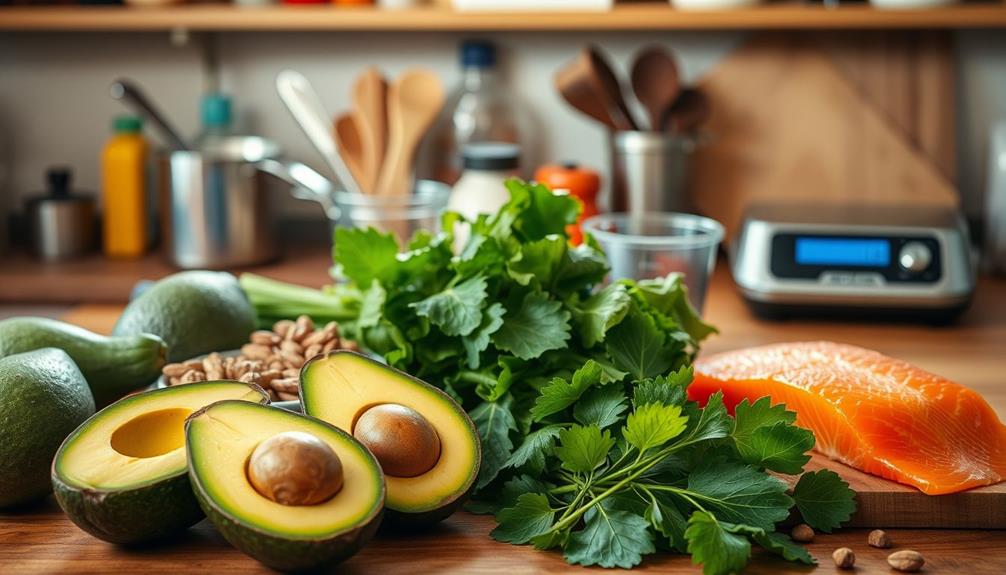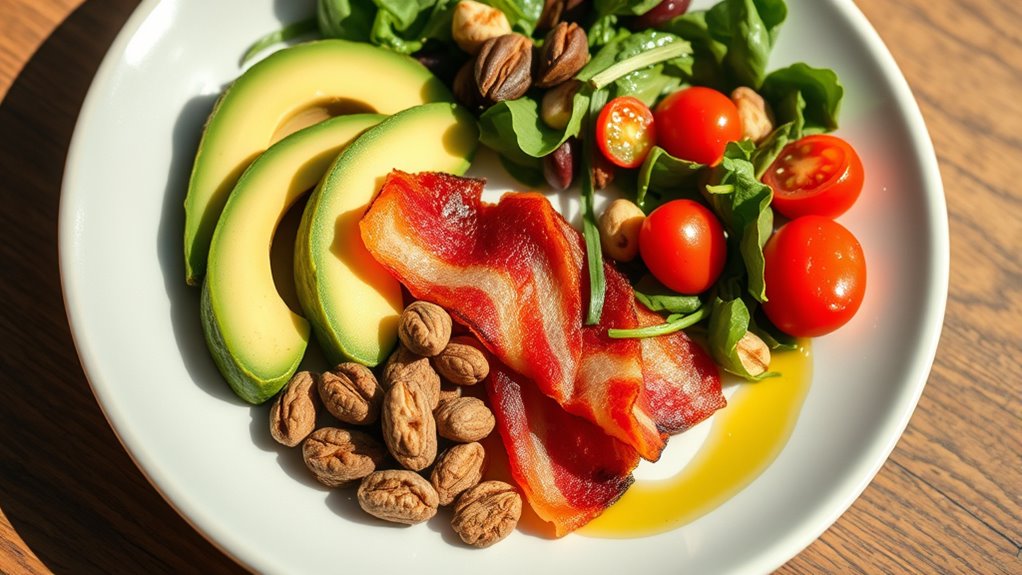

To succeed on a keto diet, you should pay attention to both calories and carbs. While limiting carbs helps your body enter ketosis, tracking calories guarantees you don’t overconsume, which can stall weight loss or cause gains. Managing your calorie intake supports fat adaptation and keeps your energy balanced. By understanding how calories influence your progress, you set yourself up for long-term success—so, keep going to discover more ways to optimize your keto journey.
Key Takeaways
- Counting calories helps ensure you’re not overeating, even with carb restrictions.
- Focusing solely on carbs may overlook excess calorie intake from fats or proteins.
- Initial calorie tracking supports effective meal planning and fat adaptation.
- Over time, as appetite stabilizes, calorie counting becomes less essential.
- Balancing both calorie and carb awareness promotes sustainable and successful keto results.
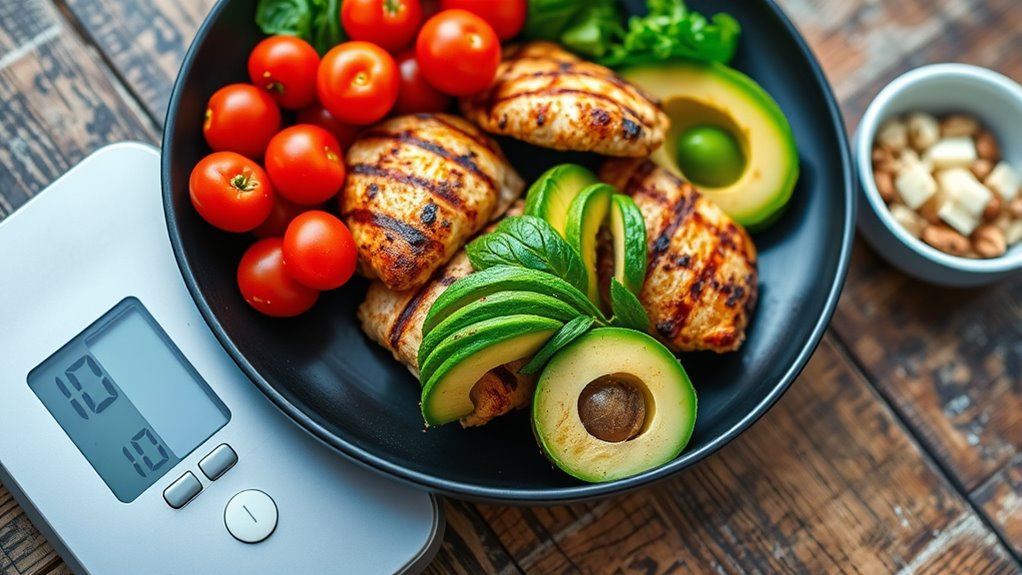
While many people focus on carb restrictions when starting a keto diet, paying attention to calorie intake remains important. It’s easy to assume that simply cutting carbs will automatically lead to weight loss, but if you don’t manage your calories, you might find yourself plateauing or even gaining weight. The key is to approach keto with a balanced plan that includes proper meal planning and a focus on fat adaptation. Meal planning helps you stay on track with your calorie goals while ensuring you’re consuming the right macronutrients to support ketosis. When you plan your meals ahead of time, you can prevent impulsive eating or reaching for high-calorie, carb-heavy snacks that can sabotage your progress.
Balancing calorie intake with meal planning supports keto success and prevents plateaus.
Fat adaptation is another essential aspect to understand. As you transition into ketosis, your body shifts from relying on glucose for fuel to burning fat. This process takes time—usually a few weeks—and during this period, paying attention to calories can accelerate your progress. If you consume too many calories, even from healthy fats, you might slow down fat burning or cause weight gain. Conversely, if you’re too restrictive on calories, you risk depriving your body of essential nutrients needed for energy and recovery. Finding the right balance involves listening to your hunger cues and adjusting your calorie intake accordingly.
Counting calories on keto isn’t about obsessing over every single bite but about awareness. It helps you understand how much energy you’re providing your body and whether your meal planning aligns with your weight management goals. Many keto followers find that once they’ve established fat adaptation, they naturally feel more satisfied and less tempted to overeat, making calorie counting less burdensome. Still, in the early stages, being mindful of calories can prevent common pitfalls like overeating high-fat foods that are easy to consume in excess.
In essence, you don’t need to meticulously track calories forever, but during the initial phase of keto, it’s a useful tool. It supports effective meal planning, ensures you’re eating enough to sustain energy levels without excess, and helps your body smoothly transition into fat adaptation. Over time, as your body becomes more efficient at burning fat, you may find that your appetite naturally regulates, and calorie counting becomes less necessary. For now, focusing on both carbs and calories gives you a solid foundation for a successful and sustainable keto journey.
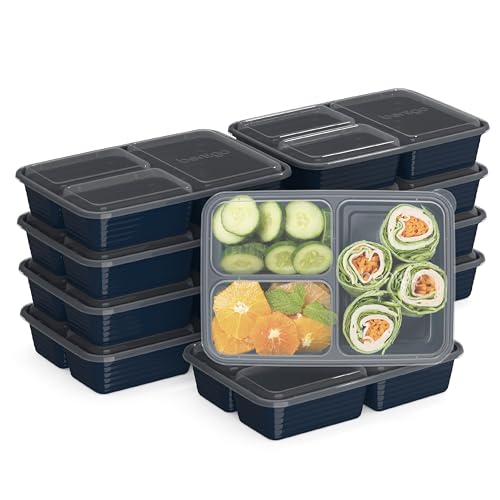
Bentgo Prep – 20-Piece 3-Compartment Reusable Meal Prep Containers with Lids, PFAS & BPA Free Materials, Durable, Microwave, Freezer, & Dishwasher Safe To Go Food Storage (Navy Blue)
#1 Brand Pick for Meal Prep Containers: Bentgo is the top pick for meal prep containers!* This lightweight,…
As an affiliate, we earn on qualifying purchases.
As an affiliate, we earn on qualifying purchases.
Frequently Asked Questions
Can I Eat Unlimited Fats on a Keto Diet?
You can’t eat unlimited fats on a keto diet without risking weight gain. While fat intake is a key part of keto, moderation matters, and tracking helps make certain you stay in ketosis. Pay attention to meal timing and portion sizes, especially if you’re aiming for weight loss. Focus on healthy fats and balance your meals, so you get enough energy without overdoing it on fats.
How Does Exercise Impact Calorie Needs on Keto?
Think of your body as a car; exercise impacts your calorie needs like adding more fuel. When you work out on keto, you burn extra calories, helping you create a calorie deficit faster. This means you might not need to count every calorie, but understanding how exercise impacts your calorie needs helps you stay on track. Regular activity boosts fat loss and keeps your energy levels steady on your keto journey.
Is Calorie Counting Necessary for Weight Loss Success?
Calorie awareness can boost your weight loss on keto, but strict calorie counting isn’t always necessary. Focus on listening to your hunger cues and eating until satisfied, rather than tracking every calorie. Staying mindful of portion sizes and choosing nutrient-dense foods helps you naturally control intake. By tuning into your body’s signals, you can achieve your goals without obsessing over calories, making your keto journey more sustainable and enjoyable.
Do I Need to Track Macros if I Count Calories?
You don’t necessarily need to track macros if you’re already doing calorie tracking, but it can help with macro management. Monitoring your macros guarantees you’re staying within your keto targets, especially for carbs, fats, and proteins. If weight loss stalls or you’re not seeing the desired results, tracking macros alongside calories gives you more precise control. It’s a useful tool to optimize your keto plan and reach your goals efficiently.
What Are the Signs of Overeating on Keto?
Overeating on keto can be signaled by persistent hunger cues despite consuming enough fats and protein intake. An interesting stat shows that 70% of keto dieters experience reduced hunger, so if you’re still hungry after meals, it might indicate overeating. Look out for signs like fatigue, brain fog, or weight stalls. These clues suggest you’re eating too much, even on keto, and should adjust portion sizes accordingly.

Etekcity Food Kitchen Scale, Digital Grams and Ounces for Weight Loss, Baking, Cooking, Keto and Meal Prep, LCD Display, Medium, 304 Stainless Steel
𝗘𝗳𝗳𝗼𝗿𝘁𝗹𝗲𝘀𝘀 𝗪𝗲𝗶𝗴𝗵𝗶𝗻𝗴: Supports 5 units (oz/lb:oz/fl'oz/g/mL), tare function, and includes 2 AAA batteries for hassle-free operation
As an affiliate, we earn on qualifying purchases.
As an affiliate, we earn on qualifying purchases.
Conclusion
So, here’s the irony: on keto, you might think counting calories doesn’t matter, but ignoring them can still sabotage your goals. While carbs take center stage, those sneaky calories from fats and proteins can sneak up on you. So, go ahead—enjoy your keto journey, but don’t forget that even in a world of low carbs, a calorie’s still a calorie. After all, ignoring them might just be the biggest calorie mistake you make.

Etekcity Smart Food Kitchen Scale with Nutritional Calculator, Free App with 19 Nutrients Tracking, Calorie, Marco, Digital grams and ounces for weight loss, Premium Stainless Steel, 11lb
𝗬𝗼𝘂𝗿 𝗛𝗲𝗮𝗹𝘁𝗵 𝗘𝘅𝗽𝗲𝗿𝘁: Easily track your intake of up to 19 nutrients, monitor trends, create daily, weekly and…
As an affiliate, we earn on qualifying purchases.
As an affiliate, we earn on qualifying purchases.

The Easy 5-Ingredient Ketogenic Diet Cookbook: Low-Carb, High-Fat Recipes for Busy People on the Keto Diet
As an affiliate, we earn on qualifying purchases.
As an affiliate, we earn on qualifying purchases.