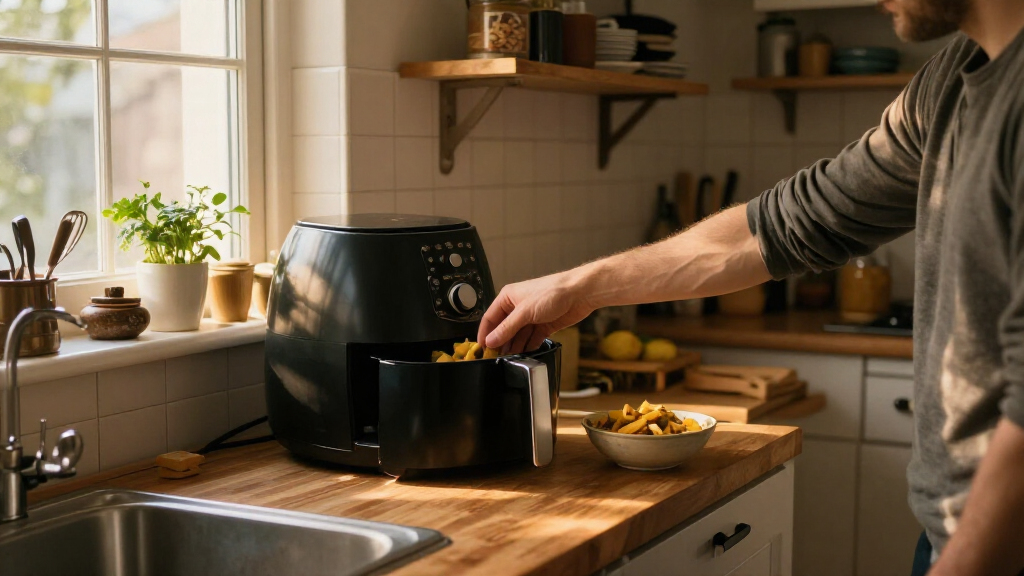

Choose an air fryer that fits your available counter or cupboard space, cooks the portions you need, and can be used safely in a compact kitchen. This guide is for first-time buyers and anyone replacing an appliance in a small home. Allow 30-45 minutes to measure your space, compare models, and prepare a cooking and storage spot; the first meal takes additional time.

Get kitchen staples and gadgets delivered free with Prime
- Fast, free delivery on millions of items
- Prime Video, Amazon Music and more included
- Member-only deals all year
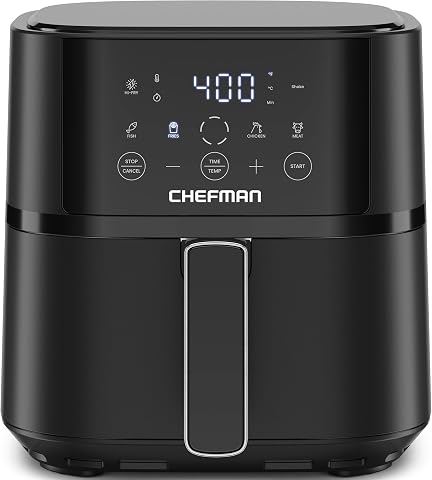
Chefman TurboFry Touch 4-Quart Air Fryer
- ✔ Capacity: 4 quarts (3.7 liters)
- ✔ Dimensions: 13.82 × 10.04 × 10.24 inches
- ✔ Power: 1500 watts

Chefman TurboFry Compact Air Fryer, 3.5-Quart
- ✔ Capacity: 3.5 quarts
- ✔ Dimensions: 14.29 × 9.64 × 8.46 inches
- ✔ Power: 1300 watts

Chefman 2-Quart Digital Mini Air Fryer
- ✔ Capacity: 2 quarts
- ✔ Dimensions: 10 × 10 × 8.3 inches
- ✔ Power: 900 watts
Difficulty: Beginner | Time: 30-45 minutes to measure, compare, and set up; cooking time varies by recipe
What You’ll Need
Tools & Materials:
- Tape measure or ruler
- Paper or a notes app
- Access to product dimensions and manufacturer instructions
Knowledge:
- A rough idea of how many people you usually cook for
- Basic familiarity with your kitchen outlets and available counter space
Check the appliance’s full dimensions, including the space its basket or door needs when opened. Manufacturers may specify clearance around the unit for heat and airflow. Follow the instructions for the specific model; compact placement does not override those requirements.
Chefman TurboFry Touch 4-Quart Air Fryer
For a small kitchen that still needs to cook more than a single portion, the 4-quart TurboFry Touch makes the strongest compromise in this lineup. Its capacity is larger than the 2-quart Mini’s, so it gives us more room for shared sides or a modest meal without jumping to a much larger appliance. The listed footprint is also fairly compact, although depth is the dimension to check against a shallow counter or cabinet.The standout distinction is Hi-Fry finishing at 450°F: during the final two minutes, the unit raises its temperature for a hotter finish. That gives it a capability the 3.5-quart model’s standard temperature specification does not list. Four presets, an audible halfway reminder, and dishwasher-safe basket and rack make routine cooking and cleanup simpler. The tradeoff is that 4 quarts remains a small-household capacity, and there is no viewing window for checking food without pulling out the basket. Choose it for the best all-round balance; skip it if minimum storage footprint matters more than cooking flexibility.
Pros:
- 4-quart capacity is roomier than the 2-quart Mini.
- Hi-Fry mode reaches 450°F for the final two minutes.
- Four presets and an audible halfway shake reminder.
- Dishwasher-safe basket and rack; automatic shutoff.
Cons:
- Capacity may require batches for larger meals or households.
- No viewing window.
- Listed depth may be awkward for shallow counters or cabinets.
Best for: Small households of two to four who want a flexible basket size and a hotter finishing mode.
Not ideal for: Solo cooks with very limited storage, or anyone who wants a viewing window or larger batch capacity.
Bottom line: We recommend the 4-quart TurboFry Touch when a small kitchen needs a useful balance of capacity, compact dimensions, and finishing flexibility.
“We recommend the 4-quart TurboFry Touch when a small kitchen needs a useful balance of capacity, compact dimensions, and finishing flexibility.”
Chefman TurboFry Compact Air Fryer, 3.5-Quart
The TurboFry Compact 3.5-Quart sits between the other two models in capacity, but its strongest case is the combination of a slim listed width and a different basket coating. At 9.64 inches wide, it may fit a narrow counter where the 4-quart model’s 10.04-inch width is less convenient. Measure the full depth, though: its listed depth is 14.29 inches, so “compact” does not mean shallow.Its PFAS-free ceramic nonstick coating distinguishes it from the other two models, which list nonstick surfaces without specifying ceramic. Four functions—air fry, bake, dehydrate, and frozen—also make it a more versatile choice than the Mini’s basic touch-control setup. Compared with the 4-quart pick, it gives up half a quart and does not list a Hi-Fry finishing mode; compared with the Mini, it is larger and better suited to more than one small portion. The basket and crisper rack are top-rack dishwasher safe. We would pick it for the coating and function set, while checking that the longer depth works in our kitchen.
Pros:
- 3.5-quart capacity bridges the gap between the lineup’s other sizes.
- PFAS-free ceramic nonstick coating.
- Air fry, bake, dehydrate, and frozen-food functions.
- Basket and crisper rack are top-rack dishwasher safe.
Cons:
- Listed 14.29-inch depth may take more counter space than expected.
- Smaller capacity than the 4-quart TurboFry Touch.
- The stated capacity may limit batch size for larger households.
Best for: Buyers who want a mid-size basket, a PFAS-free ceramic coating, and dedicated frozen-food and baking functions.
Not ideal for: Anyone with a shallow counter, or shoppers who prioritize the largest basket or smallest overall capacity.
Bottom line: We would choose the 3.5-quart TurboFry Compact for its ceramic coating and useful functions, provided its depth fits our counter.
“We would choose the 3.5-quart TurboFry Compact for its ceramic coating and useful functions, provided its depth fits our counter.”
Chefman 2-Quart Digital Mini Air Fryer
When every inch of counter or cabinet space counts, the 2-quart Digital Mini is the clearest choice here. Its 10 × 10 × 8.3-inch dimensions and square basket make it easier to place and store than the larger-capacity alternatives. That compactness comes with a real limit: the basket is intended for meals for one to two people, so we should expect smaller batches than with either TurboFry model.The Mini keeps the essentials: touch controls, temperature adjustment up to 400°F, an audible shake reminder, automatic shutoff, and dishwasher-safe basket parts. At 900 watts it is the lowest-power model in the group, while the 4-quart TurboFry Touch offers more capacity and a 450°F finishing mode and the 3.5-quart Compact adds baking, dehydrating, and frozen-food functions. Its aluminum and plastic construction includes plastic components, a practical consideration for buyers comparing materials. This is a focused small-appliance pick for straightforward portions, not the best option when we regularly cook for guests or want multiple cooking functions.
Pros:
- Smallest listed dimensions in this lineup.
- Square 2-quart basket suits compact storage and modest portions.
- Audible shake reminder and adjustable touch controls.
- Dishwasher-safe basket and rack; automatic shutoff.
Cons:
- 2-quart capacity is limiting for shared meals or batch cooking.
- Temperature tops out at 400°F.
- Housing includes plastic components.
Best for: One or two people who want a small appliance for individual portions and simple everyday cooking.
Not ideal for: Households that need larger batches, frequent shared meals, or more cooking modes.
Bottom line: We recommend the Digital Mini when saving space and cooking one or two portions matter more than basket capacity or extra functions.
“We recommend the Digital Mini when saving space and cooking one or two portions matter more than basket capacity or extra functions.”
As an Amazon Associate we earn from qualifying purchases.
Before You Start
Decide where the air fryer will operate and where it will be stored. A unit that fits on a shelf may still be awkward to lift or use there. Keep it away from sinks, curtains, paper, and other heat-sensitive items, and do not plan to run it inside a closed cupboard. Confirm that the chosen surface is stable, heat-resistant as directed by the manufacturer, and near an appropriate outlet without stretching the cord across a walkway.
Compare usable cooking capacity as well as outside dimensions. Basket shape, interior layout, and recommended food spacing affect how much you can cook in one batch. A smaller model may save space but require multiple batches for a household meal.
Step-by-Step Instructions
Step 1: Measure the available space
Measure the width, depth, and height of the place where you plan to operate the appliance. Add the clearance stated in the manual or product specifications, and check that the basket or door can open fully without hitting a wall, cabinet, or handle. If you plan to store the air fryer elsewhere, measure that shelf or cupboard too, including its opening.
Tip: Allow room to remove the hot basket and set it down safely. Do not rely on the appliance’s body dimensions alone.
Check: You have written down an operating footprint and a separate storage space, with clearance and opening room included.
Step 2: Set your portion and cooking needs
Write down how many people you usually cook for and the foods you expect to make. Think about whether you mainly want snacks and side dishes, or full portions such as vegetables and a protein. Check the manufacturer’s capacity guidance and basket dimensions against those meals rather than choosing by the advertised number of quarts or liters alone.
Tip: Food often cooks better when arranged in a single layer or with room for air to circulate. A basket that holds a large pile may still need several batches for crisp results.
Check: You can name the usual portions and meal types your preferred capacity needs to handle.
Step 3: Compare compact models
Compare a few models that fit your measured space. For each, check outside dimensions, capacity, basket or door clearance, weight, cleaning instructions, and the required operating clearance. Read whether removable parts are dishwasher-safe, and check warranty and replacement-part information if these matter to you. Choose the smallest model that can handle your typical portions without frequent crowding.
Tip: Extra functions and accessories can add bulk and storage needs. Keep only features you expect to use.
Check: Your chosen model fits the operating and storage spaces and suits your usual cooking portions.
Step 4: Choose a stable operating location
Place the appliance on a level surface that meets the manufacturer’s heat and clearance requirements. Keep the air outlet unobstructed and point it away from walls, cabinets, and items that could be damaged by hot air. Use an outlet as directed in the manual, and keep the cord clear of the counter edge, sink, and walking path.
Tip: If you need to move the unit between storage and the counter, let it cool and handle it with dry hands. Check its weight before lifting it from a high shelf.
Check: The air fryer sits steadily, has the specified clearance, and its cord and hot-air outlet are clear.
Step 5: Read the controls and prepare the appliance
Read the quick-start and safety sections of the manual before the first use. Identify how to remove and lock the basket, set temperature and time, pause cooking, and clean the parts. Wash removable components as instructed, dry them fully, and perform any initial heating or preparation the manufacturer specifies.
Tip: Do not immerse the main appliance or use abrasive tools unless the manual explicitly permits it.
Check: You can operate the basic controls and know which parts may be washed and how.
Step 6: Cook a small first batch
Choose a familiar food and follow a recipe or the manufacturer’s guidance for temperature and time. Arrange food with space for air to circulate, and avoid exceeding the fill guidance. Start with the recommended cooking time, then pause and check doneness using safe handling and a food thermometer when appropriate. Shake or turn food only if the recipe or manual recommends it.
Tip: The basket and food are hot when cooking ends. Use the handle, keep your face and hands away from escaping steam, and place the basket on a heat-safe surface.
Check: The food is cooked to the appropriate doneness, and you can repeat or adjust the batch size based on the result.
Step 7: Clean and store it safely
Switch off and unplug the air fryer, then let it cool completely. Clean the basket, tray, and interior as directed by the manual; remove food residue without scraping nonstick surfaces. Dry removable parts before storing. Leave the appliance accessible in its operating spot or move it to a storage place only when it is cool and dry.
Tip: Check the heating area for residue after cooling, but do not pour water into the appliance body.
Check: The appliance and removable parts are clean and dry, and the storage location keeps the unit stable and easy to retrieve.
Common Mistakes to Avoid
- Buying by capacity label without checking outside dimensions. — Compare the listed width, depth, height, opening clearance, and storage fit before selecting a model.
- Crowding the basket to cook a full meal in one batch. — Follow the fill guidance and leave space around food. Cook in batches when needed for even airflow and browning.
- Running the appliance beneath cabinets or beside heat-sensitive items without required clearance. — Use the clearance and placement instructions in the model’s manual, and keep the outlet and surrounding area unobstructed.
- Putting the air fryer away while it is hot or damp. — Unplug it, allow it to cool completely, and dry cleaned parts before storing.
Troubleshooting
Problem: The air fryer fits on the counter, but the basket cannot open fully.
Solution: Move it to a location with enough front clearance or choose a model with an opening arrangement that fits your measured space. Do not force the basket against a wall or cabinet.
Problem: Food cooks unevenly or stays soft.
Solution: Reduce the amount in the basket, arrange food with more space, and follow recipe guidance for shaking or turning. Check that the air outlet is not blocked.
Problem: The appliance gives off an unexpected smell or visible smoke.
Solution: Stop cooking and switch off the appliance. Follow the manual’s guidance, check for excess oil or food residue once it is cool, and contact the manufacturer if the issue persists or the smell suggests an electrical fault.
Problem: There is no convenient place to use or store the appliance.
Solution: Re-measure shelves, counter corners, and other stable surfaces while including operating clearance and basket access. If none meet the manual’s requirements, choose a smaller model or another appliance suited to the available space.
What Success Looks Like
Your air fryer fits its operating location with the required clearance, can be opened and unloaded safely, and has a practical storage spot if it will not stay on the counter. You can cook your usual portions without blocking airflow, clean the removable parts as directed, and identify when food is properly cooked. The cord, outlet, and surrounding counter remain clear during use.
Next Steps
After the first few uses, note which foods need a smaller batch or a time adjustment and keep those settings with the recipe. Clean residue after each use according to the manual. Recheck the operating area if you move the appliance or change the counter layout. Contact the manufacturer for persistent faults, damaged cords, or unclear safety instructions.
Frequently Asked Questions
What size air fryer works in a small kitchen?
Choose by measured footprint and typical portions together. A compact unit can work well for snacks or side dishes, while regular meals for several people may need a larger basket or multiple batches. Check the model’s dimensions and capacity guidance before buying.
Can I store an air fryer in a cupboard?
Yes, if the cupboard has enough room and the appliance is cool and dry before storage. Take the air fryer out to operate it unless the manufacturer specifically gives instructions for another setup; do not run it inside a closed cupboard.
Can I put an air fryer under a cabinet?
Only if the manufacturer’s clearance and placement requirements are met. Hot air may leave through an outlet, so keep that area clear and protect nearby surfaces as the manual directs.
Do I need to preheat an air fryer?
Follow the recipe and the instructions for your model. Some foods benefit from preheating, while some models or recipes do not require it. Do not add an extra preheat cycle if the manual or recipe advises against it.
How do I know when food is done?
Check the recipe’s doneness cues and use a food thermometer for foods that need a verified internal temperature. Browning alone does not confirm that every food is safely cooked.