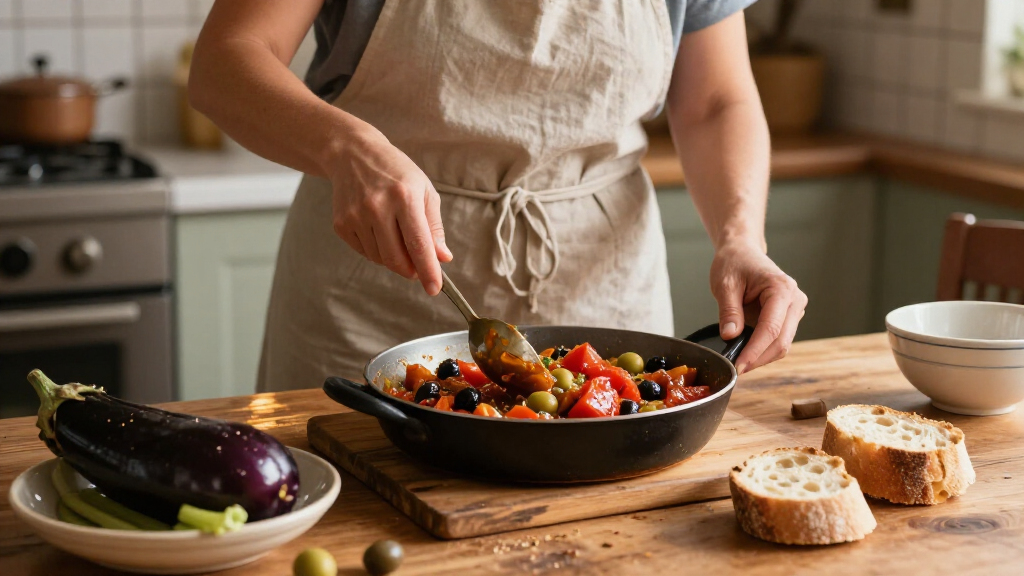

🔍 Read the full analysis: Caponata: Sicily's Sweet-and-Sour Eggplant Masterpiece on Mad Tasting

Get kitchen staples and gadgets delivered free — and shop member deals
- Fast, free delivery on millions of items
- Access to Prime Big Deal Days deals on October 6–7
- Prime Video, Amazon Music and more included
TL;DR
Caponata is a Sicilian cooked vegetable dish centered on eggplant, celery, tomatoes, olives and capers, with vinegar and sweetness forming its defining agrodolce finish. Recipes vary by household, and cooks can fry or roast the eggplant; the dish is generally served at room temperature after its flavors have rested.
Caponata, the Sicilian cooked vegetable dish built around eggplant, celery, tomatoes, olives and capers, gets its distinctive character from an agrodolce sauce that balances vinegar with sweetness. A guide from Mad Tasting describes how cooks can adjust that balance, choose between frying and roasting the eggplant, and serve the finished dish at room temperature.
The dish depends on contrasts: soft eggplant gives the sauce body, celery contributes a faint bitterness, and olives and capers bring a salty, briny flavor. Tomatoes add moisture and help the ingredients come together. Vinegar supplies the sharp side of agrodolce, while a little sugar or ingredients such as raisins can soften it. The aim is a rounded sweet-and-sour taste, not a dessert-like sweetness.
Mad Tasting presents frying and roasting as two ways to prepare the eggplant. Frying produces a richer, silkier texture; roasting is described as a lighter option. The guide recommends letting the cooked dish rest so its flavors can settle, then serving it at room temperature, with bread or as part of an antipasto spread. It can also accompany a main course.
The source does not provide a single fixed formula. It says recipes vary between Sicilian households and may include additions such as raisins, pine nuts, peppers or almonds. Because olives and capers can add substantial salt, cooks are advised to taste as they go and make small adjustments after the vegetables have cooked. Bread offers a practical test: a spoonful on plain toast can reveal whether the mixture has enough acidity and flavor without becoming too sharp or salty.
A Sicilian kitchen guide · Mad Tasting
Caponata: Sicily’s Sweet-and-Sour Eggplant Masterpiece
A flexible cooked vegetable dish built on tender eggplant, briny olives and capers, and a bright agrodolce finish. Its best balance comes from tasting and adjusting after cooking.
01 / The flavor architecture
Build a dish of contrasts
Each ingredient brings a distinct note. The goal is harmony, with no single flavor overpowering the vegetables.
Eggplant
Mild and soft, it gives the sauce a generous base for stronger flavors.
Celery
A faint bitterness adds lift and contrast to the tender vegetables.
Tomatoes
Moisture helps the ingredients come together; sweetness varies by tomato.
Olives
Salty, savory flavor adds depth, so season cautiously at the end.
Capers
A concentrated briny note sharpens the vegetable mixture.
Vinegar + sweet
Vinegar gives brightness; a little sugar or raisins round its sharpness.
02 / The balancing act
Tune the sweet-and-sour finish
There is no fixed ratio in the guide. Adjust in small steps to suit the ingredients in your pan.
Vinegar brings a lively edge, while sweetness softens its bite. Too much of either can mask the vegetables. Olives and capers add savory depth, but also contribute salt.
Let the dish cook and settle, then taste. If it feels sharp, add a little sweetness; if it tastes flat, try a small splash of vinegar. Taste before adding extra salt, especially as the sauce reduces.
Illustrative balance only—not a measured recipe ratio. Test a spoonful on plain toast to see whether the flavors hold together.
03 / Choose your texture
Fry for silk, roast for lightness
Mad Tasting offers two approaches, with neither framed as the one correct method.
Frying
Richer finishFrying gives eggplant a richer, silkier quality that settles into the sweet-and-sour sauce.
Silky · full-bodiedRoasting
Lighter finishRoasting is the lighter option, letting the eggplant stay part of a less rich version.
Lighter · flexible04 / From pan to table
Cook, rest, taste, serve
A practical sequence for adapting the dish to the ingredients you have.
Choose a method
Fry for a silkier result or roast for a lighter one.
Cook the vegetables
Bring eggplant, celery, tomatoes, olives and capers together.
Adjust after cooking
Taste before adding salt; tune acidity and sweetness in small amounts.
Rest and serve
Let flavors settle; serve at room temperature with crusty bread or antipasto.
05 / A living tradition
One dish, many household versions
Caponata varies across Sicily and from kitchen to kitchen. Its familiar core leaves room for personal touches.
A common base combines eggplant, tomatoes, celery, olives, capers, vinegar and some sweetness. Optional additions can shift both flavor and texture, so the final seasoning may need to shift too.
Mad Tasting describes caponata as adaptable rather than governed by one definitive formula. The guide provides general kitchen advice, not a tested recipe with exact measurements or cooking times.
The name may connect to capone, a local name for a fish once served with sweet-and-sour sauce. The idea that caponata developed as an accessible vegetable alternative is a possibility, not a verified explanation.
06 / What the guide does not establish
Open questions, honest limits
The article is practical guidance, not a breaking culinary announcement or a standardized recipe.
No fixed ratio
The guide gives no standard ingredient proportions, full measurements, or precise cooking times.
No single definitive version
Ingredients and proportions vary around Sicily and between households; no version is named as the only correct one.
History remains uncertain
The proposed link to capone is tentative. The source does not document when or where caponata first appeared.
No event or follow-up
No publication date, named chef, direct interview, new launch, storage limit, or scheduled announcement is reported.
07 / Quick answers
Caponata, at a glance
What is caponata?
A Sicilian cooked vegetable dish, commonly made with eggplant, celery, tomatoes, olives and capers, finished with sweet-and-sour agrodolce.
Hot or cold?
The guide recommends resting it and serving at room temperature. It does not give storage or refrigeration instructions.
Fried or roasted eggplant?
Either works: frying is richer and silkier; roasting gives a lighter result.
Where does the name come from?
One possible explanation links it to capone, a fish served with sweet-and-sour sauce. The story remains unconfirmed.
Try this: Spoon a little onto plain toast before serving. If it tastes flat, add a small splash of vinegar; if too sharp, round it with a little sweetness. Taste before adding salt.
Why Caponata’s Balance Matters
The dish’s appeal rests on how its ingredients counter one another rather than on a rigid list of measurements. Briny olives and capers intensify mild vegetables, while vinegar cuts through the eggplant’s richness. A little sweetness can round off the acidity, but too much may obscure the vegetables and make the result taste more like relish.
That balance also explains caponata’s range at the table. A small serving can work as an antipasto, while bread absorbs some of the sauce and makes it easy to serve casually. For home cooks, the practical point is to season gradually: the saltiness of the olives and capers, along with the sweetness and moisture of the tomatoes, can vary from one batch to another.
The guide’s cooking-method comparison gives readers a choice in texture and richness rather than declaring one approach definitive. That flexibility, alongside the room-temperature serving suggestion, makes caponata adaptable to different kitchens and meals while keeping its core sweet-and-sour profile.
As an affiliate, we earn on qualifying purchases.
A Dish With Household Variations
The source describes caponata as a dish with a familiar foundation but no single definitive recipe. Eggplant, tomatoes, celery, olives, capers and vinegar form the common base; other ingredients may change from household to household. Raisins can add sweetness, nuts contribute texture, and peppers alter the vegetable mix. These variations affect how the finished dish should be seasoned, so the guide treats recipes as starting points rather than strict standards.
The name’s history is less certain. The source notes that “caponata” is sometimes linked to capone, a local name for a fish historically served with a sweet-and-sour sauce. One proposed story says a vegetable preparation became a more accessible alternative, but the source describes that account as unsettled. The connection should not be treated as established history.
What is clearer in the guide is the dish’s defining combination: cooked vegetables, salty preserved ingredients and a lively sweet-and-sour finish. The source connects that combination to Sicily’s produce and pantry, while stopping short of claiming one origin story or ingredient list as definitive.
““Agrodolce” means “sour-sweet.””
— Mad Tasting guide
As an affiliate, we earn on qualifying purchases.
What the Source Leaves Open
The guide does not establish one authoritative ingredient ratio or a single preparation as the correct version. Its discussion supports a common base and several optional additions, but it does not give a complete recipe with measured quantities in the supplied material. The best balance will also depend on the saltiness of the olives and capers and the sweetness of the tomatoes.
The proposed link between caponata and capone is presented as a possibility, not a proven origin. The supplied source material also does not specify refrigerator storage times or safe handling temperatures. Readers should follow established food-safety guidance for cooked vegetables rather than infer a storage window from the serving advice.
As an affiliate, we earn on qualifying purchases.
How to Serve and Adjust It
After cooking, let the caponata rest before serving it at room temperature, as the guide recommends. Taste a spoonful on plain toasted bread. If vinegar feels too sharp, allow more resting time and then consider a small addition of sweetness; if the mixture tastes flat, a little more vinegar may brighten it. If capers dominate, the source suggests adding cooked eggplant or tomato rather than more salt.
Make changes in small amounts, particularly when adding raisins or sugar, because sweetness can quickly overtake the vegetables. Serve the dish with bread, as an antipasto, or alongside a simple main course. For any leftovers, use standard safe handling: refrigerate promptly in a covered container and keep cold; the source does not give a specific storage duration.
As an affiliate, we earn on qualifying purchases.
Key Questions
What is caponata?
Caponata is a Sicilian cooked vegetable dish commonly made with eggplant, celery, tomatoes, olives and capers. Its characteristic flavor comes from agrodolce, a balance of vinegar and sweetness.
Is caponata supposed to taste sweet?
It should taste sweet-and-sour, not like dessert. A little sweetness rounds the vinegar’s sharpness, while too much can mask the vegetables and weaken the dish’s bright finish.
Should I fry or roast the eggplant?
According to the Mad Tasting guide, frying gives the eggplant a richer, silkier texture, while roasting produces a lighter result. The source does not designate either method as the only correct choice.
Can caponata recipes include raisins or nuts?
Yes. The source says some versions include raisins, pine nuts, peppers or almonds. These additions change the dish’s sweetness or texture, so taste before adding more seasoning.
How is caponata served?
The guide recommends serving it at room temperature, after the flavors have rested. It can be spooned onto bread, served as antipasto or offered as a side dish. Refrigerate leftovers promptly and follow standard food-safety practices.
Source: Mad Tasting
NFL season / tailgating Picks
team gear
As an affiliate, we earn on qualifying purchases.