TL;DR

Get kitchen staples and gadgets delivered free with Prime
- Fast, free delivery on millions of items
- Prime Video, Amazon Music and more included
- Member-only deals all year
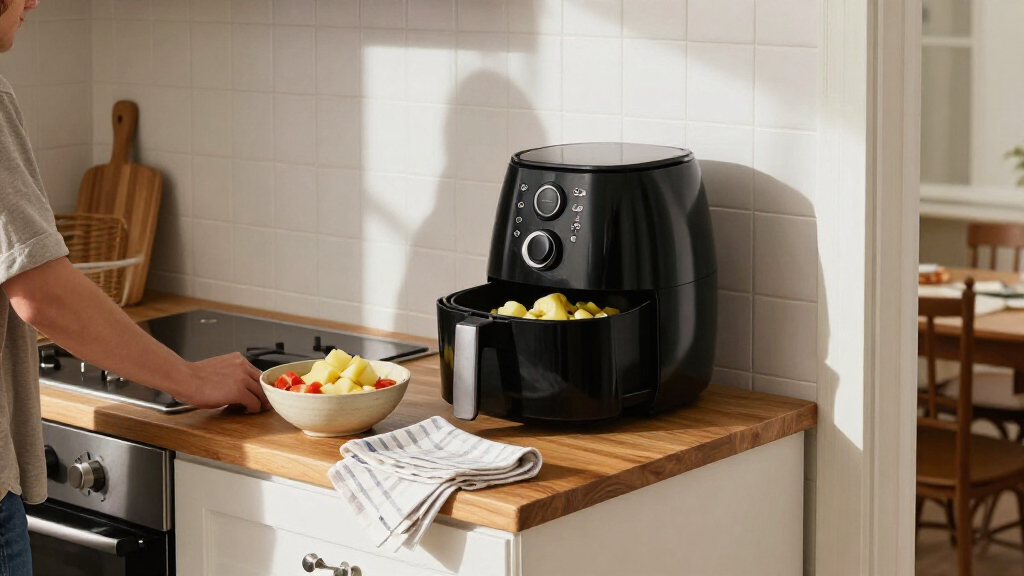
For a small kitchen, choose an air fryer by measuring its footprint, ventilation clearance, and basket access, then compare usable cooking area with the portions you make. Compact basket models often suit one or two people, while oven-style and dual-basket models add flexibility at the cost of more space; avoid crowding food, follow the manual’s safety guidance, and clean the appliance as directed.
Measure the fryer, basket access, and manufacturer-specified ventilation clearance before buying.
Compare usable basket area with your usual portions; capacity labels vary across brands.
Leave space around food for more even browning, and cook in batches when needed.
Choose controls, cleanup, and storage features you’ll use regularly over a long list of extras.
Follow your model’s instructions for placement, hot parts, cleaning, and food preparation.
Why an air fryer can earn its counter space
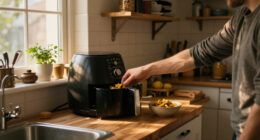
An air fryer can make quick, crisp meals with less oil than deep frying, and it heats a smaller cooking chamber than a full-size oven. Air fryers cook food by circulating hot air around it with a fan and heating element, so the appliance works like a small convection oven. That can be handy when you want roasted broccoli for one or reheated pizza without warming a large oven. The phrase “air fryer” describes a cooking method, not one standard appliance shape. A basket model is often simple and compact; an oven-style model adds shelves but usually takes more room. Dual-basket designs cook two foods at once, while lid-style or pot-style options may fit a particular storage arrangement better. These formats change the daily work involved: shelves can spread food across levels, while a basket makes it easy to shake or turn a batch. More capacity can reduce the number of rounds, but it only helps if you have room to place and open the unit. Imagine coming home late and wanting a small serving of salmon and green beans. A compact basket model may handle that meal without heating a full oven, though you may need to cook the foods in sequence if they need different temperatures. That sequencing matters: a meal that fits the appliance may still take longer if its parts need separate batches. The time and energy savings depend on the portion, model, cooking time, wattage, and local electricity price. An air fryer also doesn’t make every meal automatically healthier: ingredients and portions still count. Space and routine matter as much as crispness. If the appliance must be hauled from a high cupboard each time, it may not become the convenient helper you expected. If you use it often for quick lunches, a permanent spot may feel well earned. Consider the whole routine, from reaching the appliance to serving and cleaning it: a small cooking-time saving can be outweighed by awkward setup or repeated batches.Products Worth Considering

Ninja Foodi 8-Qt DualZone 6-in-1 Air Fryer, Grey, DZ201

Ninja Foodi Smart 6-in-1 Indoor Grill and Air Fryer, 4 Qt, Black/Silver, FG551

Cuisinart CPZ-120 Indoor Countertop Pizza Oven, Stainless Steel
As an affiliate, we earn on qualifying purchases.
How to pick a model that fits your kitchen and meals
For a small kitchen, a basket air fryer is often the most compact starting point, while an oven-style or dual-basket model gives you more cooking flexibility at the cost of more counter space. Compare the appliance’s outside measurements and usable cooking area with the food you actually prepare; capacity numbers may not mean the same thing across brands. The useful question is not simply how much food fits inside, but whether it can sit in a layer that allows hot air to circulate. A larger cavity can still disappoint if the cooking surface is narrow or the food needs to be piled up.| Format | What it offers | Small-kitchen tradeoff |
|---|---|---|
| Basket | Simple cooking and a compact footprint | May need batches for larger meals |
| Dual basket | Two foods can cook at once | Wider footprint and more parts to clean |
| Oven-style | Shelves and a range of cooking functions | Usually takes more counter or storage room |
| Lid or pot style | May store differently depending on design | Check the whole shape and parts, not just the base |
Measure a safe spot before you bring one home
Measure the appliance’s footprint and leave the ventilation clearance its manufacturer specifies; then check that you can reach the controls and open or remove the cooking basket. An air fryer can seem small in a product photo but feel bulky when its handle sticks out over a narrow counter or its hot-air exhaust points toward a wall cabinet. Clearance is functional space: the unit needs it to vent as designed, and you need it to handle hot parts without bumping nearby objects.- Measure the counter or shelf where you plan to use it, including the appliance’s full width, depth, and height.
- Read the manual or product instructions for clearance and placement requirements, especially around vents and overhead cabinets.
- Check that the basket, drawer, or oven door can open completely without hitting a wall, faucet, or another appliance.
- Confirm the electrical guidance, then place the fryer where its cord and hot exhaust won’t create a snag or heat problem.
- If you’ll store it between uses, check its weight and shape and leave room for the basket and accessories.
Get crisp results without filling the basket to the brim
Air fryers cook most evenly when hot air can move around the food, so leave space instead of piling everything into the basket. Overcrowding can trap moisture and leave some pieces soft while exposed edges brown quickly. The appliance may be compact, but cooking in two lighter batches can taste better than forcing one overloaded batch. The constraint is especially noticeable with foods that release moisture or need direct exposure on several sides: more food in the basket does not always mean more food cooked well in the same time. Suppose you tip a full bag of frozen fries into a small basket before a movie. The fries touching the base may turn golden, while the ones buried in the middle stay pale and limp. A smaller layer, a shake or turn when the recipe calls for it, and a little patience usually produce a more even result. Cooking times vary by food, model, and recipe, so use the appliance instructions and check food as it cooks. If a batch is repeatedly uneven, reduce the amount or cook in a single layer where the instructions recommend it; adding time alone can overcook the exposed pieces while the crowded center catches up. You can use a small fryer for more than frozen convenience foods. Try a handful of vegetables, warmed leftovers, or a portion of protein that fits without crowding. Some recipes benefit from preheating; others don’t require it. Follow the recipe and appliance instructions rather than assuming every model needs the same routine. Those instructions help set expectations because basket shapes and airflow differ, so a time that works in one model may not transfer exactly to another. Batch cooking has a tradeoff. It may take longer overall, which can shrink the time advantage for a large family meal. But for one or two portions, a compact chamber can be quick and handy. If a meal regularly needs several rounds, that’s a sign to reconsider the basket size or cooking format. A slightly larger model may be worth the counter space if it lets you cook your usual portions without crowding; if those large meals are rare, batches may be the better compromise.Choose features that save effort instead of adding clutter
For a small kitchen, prioritize easy controls, simple cleaning, and a workable storage plan before chasing extra presets or smart features. Recent designs include digital controls, viewing windows, dual baskets, and combined functions such as roasting, baking, reheating, or dehydrating. Those options can help, but they may add bulk, accessories, and cost without making your usual meals easier. In limited space, each feature has an opportunity cost: it occupies room that could serve as prep space or hold an appliance you use more often. A clear temperature and time display may be more useful than twelve presets if you already follow recipes. A removable, dishwasher-safe basket can make cleanup easier, but check its care instructions first. Nonstick surfaces need gentle cleaning and can wear over time, so avoid assuming that every removable part can go in the dishwasher or withstand abrasive scrubbing. A feature that saves a few minutes after each meal may be more valuable over a year than a specialized mode used once, especially if cleanup is the step that makes you avoid using the appliance. Consider a person in a studio apartment who mostly makes vegetables and reheats a serving of dinner. A viewing window may be pleasant, but a compact basket with readable controls and easy cleanup could serve that routine better. Meanwhile, someone who frequently cooks two foods at once may actually use a dual basket; its extra width could replace some juggling between batches. The choice turns on frequency: paying for and storing extra capacity is easier to justify when it repeatedly solves a real timing problem. Compare the full cost of ownership. Alongside the purchase price, look at warranty coverage, replacement baskets or accessories, and parts availability. Fans also make noise, and the appliance’s exterior and exhaust can become hot. In an open-plan room, sound and placement may matter as much as a feature list. Pick the functions you can name a real weekly use for. That keeps the appliance’s price, storage footprint, and cleaning workload tied to benefits you will actually notice.Keep cleanup and food safety simple
Keep the fryer’s vents unobstructed, treat the basket and exterior as hot during and after cooking, and clean the appliance according to its manual. Food residue around the basket or heating area can build up, so regular care matters even when the appliance looks tidy from the front. Grease and crumbs can affect later cleanup and may produce smoke if left to accumulate. Unplug and cool it as directed before cleaning; don’t assume the heating area can be washed like a removable basket. A practical routine is to let the basket cool, remove crumbs, and wash its parts using the method the manufacturer allows. If a coating is nonstick, use gentle tools and cleaners recommended in the care instructions. For a small household, cleaning after a quick batch of potatoes may take only a few minutes, but leaving greasy residue for later can make the next cleanup harder. Regular, light cleaning can also help you notice damage or buildup early, when it is easier to address than after repeated cooking. Food safety still depends on the food and recipe, not just the appliance. Follow trustworthy cooking guidance for the specific ingredient, avoid cross-contamination, and refrigerate leftovers promptly according to food-safety guidance. Don’t use a crisp-looking exterior as the only sign that food is safely cooked; follow recipe directions and check doneness appropriately. Browning describes the surface, while safe doneness depends on the food’s interior, so a reliable check matters most for foods where appearance alone can mislead. Storage is fine once the unit is cool and clean. In a tiny kitchen, you may tuck it into a cupboard between uses, but factor in its weight and shape. A bulky appliance that’s awkward to lift may be less practical than a smaller one you can leave on a safe, clear spot. Include the basket and accessories in that storage plan; otherwise, loose parts can consume the space you hoped to save or make setup feel like extra work.Know when a small fryer can—and can’t—replace another appliance
An air fryer overlaps with some toaster-oven jobs, such as crisping snacks or roasting a small portion, but it doesn’t replace a microwave for rapid reheating or every oven task. Whether it saves space depends on what you already own and what you cook most often. A second appliance earns its place when it handles enough recurring jobs to offset the counter or cupboard space it occupies; overlap on paper doesn’t guarantee that it fits your routine.| Task | Air fryer fit | What to keep in mind |
|---|---|---|
| Crisping fries or vegetables | Often a useful fit | Leave room for air circulation and cook in batches if needed |
| Warming leftovers | Can work for foods you want crisp | A microwave is often faster for soft or saucy food |
| Cooking a small portion | May avoid heating a full-size oven | Actual time and energy use depend on the appliance and recipe |
| Cooking a large tray meal | Limited by basket size | An oven may handle more food in one round |