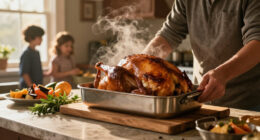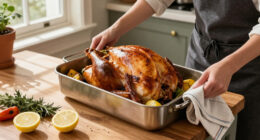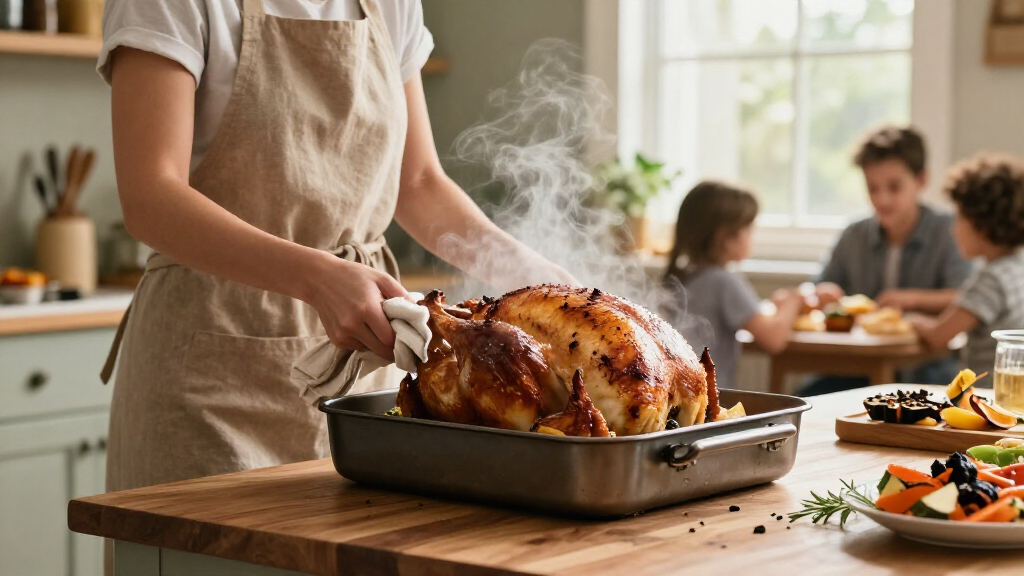

For Thanksgiving, the roasting pan has to hold a heavy bird, fit the oven, and leave enough room to make gravy afterward. The main choice is between a stainless steel roasting pan and a nonstick one: stainless steel is the stronger pick for browning, durability, and pan-sauce making, while nonstick makes cleanup easier when sticky drippings and baked-on food are the main concern. Neither material guarantees a good roast on its own; pan dimensions, sturdy handles, and a rack that fits matter just as much. Choose stainless if you want a pan for years of holiday cooking and regular roasting. Choose nonstick if effortless release and simpler cleanup outweigh long-term coating care.

Get kitchen staples and gadgets delivered free with Prime
- Fast, free delivery on millions of items
- Prime Video, Amazon Music and more included
- Member-only deals all year

EWFEN Nonstick Turkey Roasting Pan with U-Shaped Rack, 17 × 13 Inch
- ✔ Material: Aluminized carbon steel
- ✔ Pan size: 17 × 13 inches; listed item dimensions also say 15 × 8 × 3 inches
- ✔ Capacity: Up to 22 lb

KITESSENSU Nonstick Roasting Pan with Rack, 15 x 11 Inch, Gray
- ✔ Material: Carbon steel
- ✔ Dimensions: 15.3 × 11.4 × 2.1 inches
- ✔ Capacity: Up to 14 lb

Glad Nonstick Roasting Pan with V-Shaped Rack, 15 x 10.3 Inches
- ✔ Material: Carbon steel
- ✔ Dimensions: 15 × 10.3 × 2.8 inches, excluding handles
- ✔ Finish: Nonstick
At a Glance
| Criteria | Stainless steel roasting pan | Nonstick roasting pan | Winner |
|---|---|---|---|
| Browning and gravy | Excellent for browning drippings and building fond for gravy | Can roast well, but browned bits may be less accessible and require gentler methods | A |
| Food release and cleanup | Food can stick; may need soaking and scrubbing | Food releases readily and cleanup is usually easier | B |
| Durability | Long-lasting with ordinary care | Coating can scratch or wear, especially with metal tools and abrasive cleaning | A |
| Heat tolerance | Generally well suited to high roasting temperatures; check manufacturer limits | Limited by the coating and product instructions; not every model suits very high heat | A |
| Handling a large turkey | Strong choice when the pan is heavy-gauge and has secure handles | Suitable if the pan is large and sturdy; coating does not make an undersized pan fit a turkey | Depends |
| Care requirements | Usually tolerates metal utensils; avoid harsh cleaners that can scratch or dull the finish | Use nonmetal utensils, avoid abrasive pads, and follow temperature limits | A |
| Overall value | Often costs more upfront, but can repay that cost through repeated use | Often a practical buy for easier cleanup, but replacement may be needed if the coating wears | Depends |
EWFEN Nonstick Turkey Roasting Pan with U-Shaped Rack, 17 × 13 Inch
For a Thanksgiving centerpiece that may weigh as much as 22 pounds, EWFEN offers the most stated capacity in this group. Its U-shaped rack holds the bird above accumulated juices, which can help keep the underside from sitting directly in the drippings. The angled steel handles are intended to preserve cooking area while giving us points to grip when moving the pan. Compared with KITESSENSU’s 14-pound limit and Glad’s smaller 15 × 10.3-inch footprint, EWFEN is the better match for cooks prioritizing a larger bird.That extra room brings practical costs. The pan is large and may be awkward to store, and the product information lists both a 17 × 13-inch pan size and item dimensions of 15 × 8 × 3 inches. We should verify the actual footprint before counting on it to fit our oven or cabinet. Its 450°F maximum is also lower than Glad’s 464°F limit. The nonstick coating is described as free of PTFE, PFOA, cadmium, and lead, but it still calls for careful handling to preserve the surface.
Pros:
- Listed capacity supports turkeys up to 22 pounds.
- U-shaped rack raises the bird above drippings.
- Angled steel handles are designed to preserve usable cooking area.
- Coating is described as free of PTFE, PFOA, cadmium, and lead.
Cons:
- Large footprint may be difficult to fit or store.
- Product information gives conflicting dimensions.
- 450°F maximum is below Glad’s stated oven limit.
Best for: Thanksgiving cooks planning a turkey up to 22 pounds who have room to confirm the pan’s footprint in their oven and storage area.
Not ideal for: Anyone with a compact oven or limited cabinet space, or anyone who needs dimensions resolved before purchase.
Bottom line: We’d choose EWFEN for the largest Thanksgiving turkey in this lineup, after confirming its true dimensions and oven fit.
“We’d choose EWFEN for the largest Thanksgiving turkey in this lineup, after confirming its true dimensions and oven fit.”
KITESSENSU Nonstick Roasting Pan with Rack, 15 x 11 Inch, Gray
KITESSENSU is the versatile pick for households roasting a more modest bird and wanting a pan that can do another job after Thanksgiving. Remove the U-shaped rack and the 15 × 11-inch carbon steel pan can double as a baking pan. Its stated capacity reaches 14 pounds, placing it between Glad’s more compact format and EWFEN’s larger-turkey focus. Wide riveted handles also offer substantial gripping points, useful when carrying a hot pan from oven to counter.The limitation is important for holiday planning: a 14-pound maximum may rule out larger turkeys. At 450°F, its listed heat ceiling is lower than Glad’s 464°F, though still high enough for many roasting plans. The description calls the body thickened and 8 mm, which may contribute to sturdy construction but could make handling less convenient; the listed weight is 2.35 kg. Compared with EWFEN, KITESSENSU gives up capacity. Compared with Glad, it brings a broader pan-and-baking role, but no higher oven limit.
Pros:
- Removable U-shaped rack lets the pan serve as a baking pan.
- Stated capacity is up to 14 pounds.
- Wide, riveted steel handles provide substantial grip points.
- Nonstick finish and dishwasher-safe care support easier cleanup.
Cons:
- 14-pound limit may be too small for a larger turkey.
- Listed thickened body may make handling less convenient.
- 450°F maximum is lower than Glad’s stated limit.
Best for: Cooks who expect to roast a turkey of 14 pounds or less and want a removable rack so the pan can also be used for baking.
Not ideal for: Hosts planning a large turkey, or anyone who prefers a lighter pan that is easier to maneuver when full.
Bottom line: We’d pick KITESSENSU for a smaller Thanksgiving turkey when the removable rack and second use as a baking pan matter.
“We’d pick KITESSENSU for a smaller Thanksgiving turkey when the removable rack and second use as a baking pan matter.”
Glad Nonstick Roasting Pan with V-Shaped Rack, 15 x 10.3 Inches
When the Thanksgiving menu calls for a smaller turkey, or oven and cabinet space are at a premium, Glad’s compact dimensions are its advantage. The 15 × 10.3-inch carbon steel pan is the smallest listed by footprint among these options, and its V-shaped iron rack is designed to promote airflow around the roast. The stated oven limit of 464°F is also the highest of the three. Compared with KITESSENSU, Glad is narrower and has a higher listed temperature ceiling; compared with EWFEN, it is a much easier size to accommodate but does not claim capacity for a 22-pound bird.Glad’s simpler footprint comes with a narrower role. The pan is explicitly not broiler safe and must not be used on a stovetop or open flame, so it will not support every method for finishing gravy or browning. Its nonstick coating can ease food release, but metal utensils and abrasive cleaning are discouraged. The provided details do not state a turkey-weight capacity, so we should size the bird against the pan rather than assume a particular limit. Dishwasher-safe care is convenient, but gentle treatment remains sensible for a coated surface.
Pros:
- Compact 15 × 10.3-inch footprint is suited to tighter storage.
- V-shaped iron rack is designed to promote airflow.
- Highest stated oven limit in this lineup at 464°F.
- Dishwasher safe, with sturdy handles for carrying.
Cons:
- Not safe for broiler, stovetop, or open-flame use.
- No turkey-weight capacity is provided.
- Coating requires nonabrasive cleaning and nonmetal utensils.
Best for: Cooks roasting a smaller bird who value a compact pan, a V-shaped rack, and dishwasher-safe cleanup.
Not ideal for: Anyone cooking a large turkey or wanting a pan that can go under the broiler or onto a stovetop.
Bottom line: We’d choose Glad for a smaller roast and easier cleanup when its no-broiler, no-stovetop limits fit our cooking plan.
“We’d choose Glad for a smaller roast and easier cleanup when its no-broiler, no-stovetop limits fit our cooking plan.”
As an Amazon Associate we earn from qualifying purchases.
Key Differences
The biggest practical difference appears after the turkey comes out. Stainless steel lets browned drippings cling to the pan, which gives you useful flavor for gravy and pan sauces. It takes more effort to clean, but it is more forgiving of high heat, utensils, and repeated seasonal use. Nonstick turns cleanup into the easier job: food is less likely to adhere, and residue often washes away with less scrubbing. That convenience comes with a coating that needs more careful handling.
For a Thanksgiving bird, size and construction outrank the label on the surface. Check the pan’s interior dimensions against your turkey and oven, and look for a sturdy base, secure handles, and a rack that leaves room for air circulation. A small nonstick pan is still the wrong pan for a large turkey, and a flimsy stainless pan can be awkward when loaded. If you want one pan to roast meat throughout the year and make gravy from the drippings, stainless steel is usually the more versatile investment. If you roast occasionally and want to minimize cleanup, nonstick can be a sensible choice.
Detailed Comparison
Browning and gravy (Stainless steel roasting pan wins — moderate)
Stainless steel wins by a moderate margin for cooks who value gravy. It allows browned bits to form on the pan surface, where they can be loosened with liquid for a more flavorful sauce. Nonstick can roast a turkey successfully, but its surface is designed to resist sticking, so it may produce less accessible fond. For a simple roast with gravy made separately, that difference matters less.
Food release and cleanup (Nonstick roasting pan wins — moderate)
Nonstick wins by a moderate margin when easy washing is the priority. Sticky glaze and cooked-on residue generally release with less effort, which is useful after a long holiday meal. Stainless steel often needs soaking or more scrubbing, especially when drippings bake onto the surface. The tradeoff is that nonstick cleanup must use gentler tools to protect the coating.
Durability (Stainless steel roasting pan wins — major)
Stainless steel wins by a major margin for long-term use. Its cooking surface does not depend on a coating that can wear down, so it can stand up to many seasons of roasting when cared for properly. Nonstick can remain useful for years, but scratches, peeling, or reduced release can shorten its life. Frequent holiday cooks are more likely to get lasting value from stainless.
Heat tolerance (Stainless steel roasting pan wins — moderate)
Stainless steel wins by a moderate margin because it is generally compatible with high roasting temperatures and broiler finishing, subject to the pan’s handles and manufacturer guidance. Nonstick models have product-specific temperature limits, and exceeding them can damage the coating. Check the stated oven-safe temperature before buying either pan, especially if you roast at high heat.
Handling a large turkey (major difference)
This is a tie in material and a matter of construction. A well-built pan in either material can hold a holiday turkey, but loaded pans are heavy and hot, so broad, secure handles and a stable base matter. Compare usable interior dimensions with your bird and oven rather than relying on a size name alone. A flimsy or cramped pan is a poor choice regardless of its surface.
Care requirements (Stainless steel roasting pan wins — minor)
Stainless steel wins by a minor margin for flexibility. It is generally easier to use with metal utensils and less vulnerable to routine scrubbing, though abrasive cleaners can dull its finish. Nonstick calls for nonmetal utensils and gentler washing to avoid damaging the coating. If you prefer low-effort washing, nonstick may still feel easier overall despite those precautions.
Overall value (moderate difference)
The value winner depends on how often you cook and what you count as effort. Stainless steel can justify a higher upfront cost for frequent roasting, gravy making, and long service. Nonstick is often better value for an occasional cook who prioritizes easy cleanup and does not need a pan for high-heat or heavy-duty use. Pay more for stainless when you will use its durability and browning advantages.
Stainless steel roasting pan: Pros and Cons
Pros:
- Builds browned drippings useful for gravy and pan sauces
- Usually handles high roasting heat well, subject to product limits
- Durable surface suited to repeated use
- More tolerant of metal utensils than nonstick
Cons:
- Food can stick, making cleanup harder
- May need soaking or scrubbing after roasting
- Can cost more upfront than a basic coated pan
Nonstick roasting pan: Pros and Cons
Pros:
- Food releases easily and washing is usually quicker
- Convenient for occasional roasting and sticky marinades
- Can cost less upfront than a comparable stainless option
Cons:
- Coating can scratch or wear with careless use
- Requires gentler utensils and cleaning tools
- Temperature limits vary and can restrict high-heat techniques
- May provide less accessible browning for gravy
Who Should Choose What
Choose Stainless steel roasting pan if:
- You roast turkey, chicken, or meat several times a year and want a pan that can last.
- You make gravy or pan sauce from browned drippings.
- You want more freedom to use metal utensils or cook at high heat, within the manufacturer’s limits.
Choose Nonstick roasting pan if:
- You roast only occasionally and put easy cleanup ahead of fond.
- You often cook sticky or glazed foods and want them to release with less scrubbing.
- You are comfortable using nonmetal utensils and staying within the coating’s temperature limit.
Skip both if: Skip both if neither option fits your oven, turkey, or storage space; first find a sturdy pan with suitable interior dimensions, secure handles, and a compatible rack.
Value for Money
Paying more for stainless steel is worthwhile for regular cooks who will use its durability, high-heat flexibility, and gravy-friendly browning. That higher initial cost can make sense over many years of holiday and everyday roasting. A nonstick pan may be better value if you roast only once or twice a year and easy cleanup is worth more to you than long service or pan sauces. Compare construction and usable size before paying extra for a finish: a sturdy, correctly sized pan is more useful than a premium surface on the wrong shape.
Final Verdict
For most households choosing one Thanksgiving roasting pan to keep, stainless steel is the stronger recommendation. It offers more durable service and better conditions for browning drippings into gravy, making it the more versatile choice for holiday cooking and everyday roasts. Choose nonstick if you roast infrequently and the time saved on cleanup is your main priority. The deciding factor is whether you value long-term flexibility and browned-pan flavor more than easy food release.
Frequently Asked Questions
Is stainless steel or nonstick better for a Thanksgiving turkey?
Stainless steel is the better all-purpose pick if you want browned drippings for gravy and a pan suited to repeated use. Nonstick is a good fit if easy release and cleanup matter more. For either, choose a pan large enough for your turkey and oven.
Can a nonstick roasting pan make good gravy?
Yes. You can make gravy with the juices, but a nonstick surface may develop less accessible browned residue than stainless steel. If making gravy from pan drippings is central to your meal, stainless steel has the advantage.
Is it worth paying more for a stainless steel roasting pan?
Usually, if you roast often, want to make pan sauces, or expect to use the pan for many years. For an occasional Thanksgiving roast where simple cleanup matters most, a well-built nonstick pan can be better value.
What should I check before buying a Thanksgiving roasting pan?
Check the usable interior dimensions against your turkey and oven, confirm the pan’s temperature limit, and look for secure handles and a stable base. A matching rack is useful, but it should leave room around the bird for heat to circulate.